Against the God of the Gaps: Orthodox Apologetics for the Scientific Age
Introduction: A Conflict That Doesn’t Have to Be
In today’s world, many people think that science and faith are enemies. Schools and media often tell us that science explains everything and there is no need for God. Some even say believing in God is "unscientific." Sadly, many young Orthodox Christians feel confused. They ask: "Can I be both faithful and smart? Can I follow Christ and still love science?"
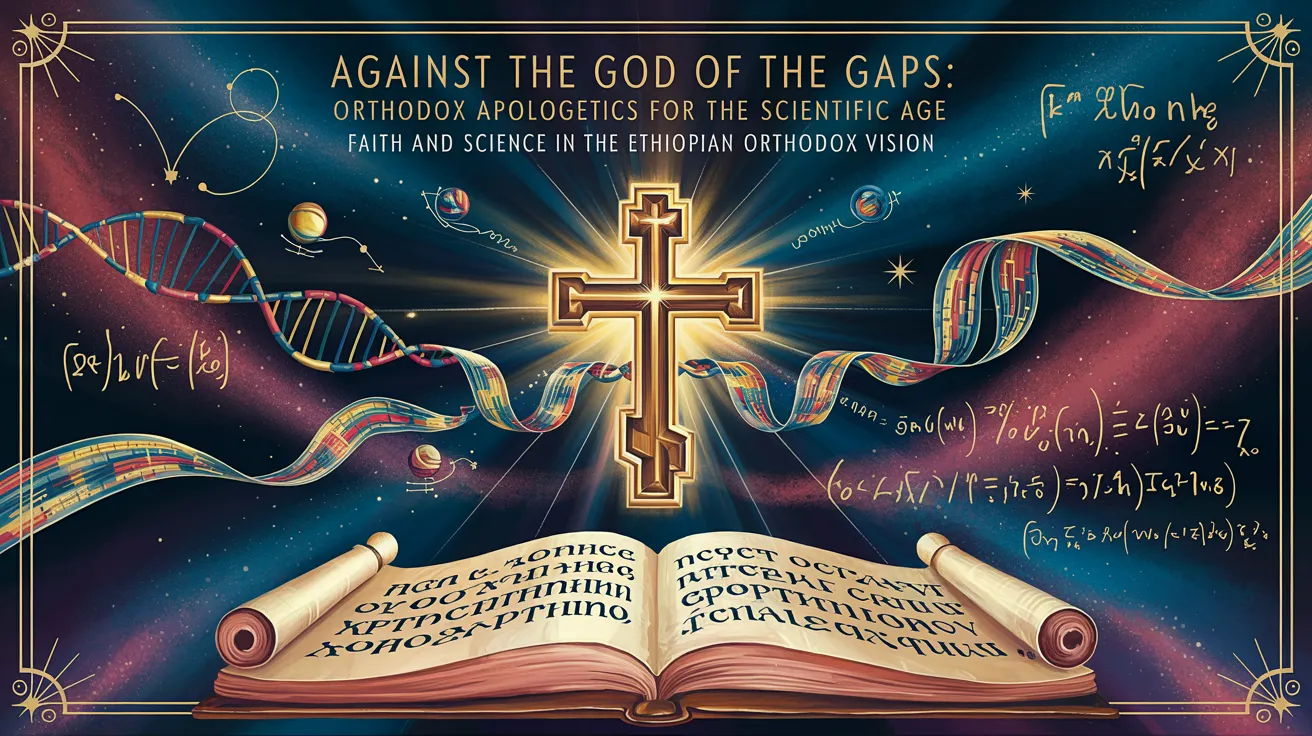
The short answer is: Yes! The longer answer is what this article will explore. In the Ethiopian Orthodox Tewahedo Church, we do not see science as a threat. Instead, we believe science can help us admire God’s wisdom and beauty in creation. But we must also avoid a dangerous mistake: thinking that God is only useful when we cannot explain something. This is the idea called the "God of the Gaps."
In this long-form article, we will explain what the "God of the Gaps" idea is, why it is wrong, and how Orthodox Christianity offers a better, deeper way of thinking about science and creation.
Table of Contents
- What is the "God of the Gaps"?
- The Orthodox View of Creation
- Patristic Wisdom: The Early Church Fathers on Nature
- Faith and Reason in Harmony
- Examples of Orthodox Wisdom in Scientific Inquiry
- Science Describes, But Theology Reveals
- The Mystical Vision of Creation
- Pastoral Words to the Youth in the Scientific Age
- Conclusion: One Truth, One Creator
1. What is the "God of the Gaps"?
The "God of the Gaps" refers to a flawed way of thinking that treats God as a placeholder for ignorance. Whenever science has no answer, people insert God. But as scientific knowledge grows, these gaps shrink—and so, people mistakenly believe that God is no longer needed.
Orthodoxy firmly rejects this. God is not an explanation of the unknown; He is the source of all that exists—seen and unseen. He is not merely the cause of what we do not yet understand but the cause of everything we do understand, rightly understood.
"He made all things in wisdom." (Psalm 104:24)
2. The Orthodox View of Creation
In Oriental Orthodoxy, the world is not a random event or a mechanical system. Creation is the deliberate act of a good and loving God.
- God created the universe from nothing (ex nihilo)
- The Word (Logos), Who is Christ, is the agent of creation
- Creation reflects divine wisdom and order
This understanding is shared across the Fathers of the Oriental Church. The created world is not just matter—it is a sacred icon revealing the invisible Creator.
"The heavens declare the glory of God; and the firmament shows His handiwork." (Psalm 19:1)
3. Patristic Wisdom: The Early Church Fathers on Nature
The early Fathers of the Oriental Orthodox Church never feared knowledge. Their writings reveal deep reverence for the created world:
- St. Basil the Great (4th c., Cappadocian Father accepted by Oriental Orthodox) in his Hexaemeron speaks in detail about the natural world, from plants to stars, always pointing back to divine wisdom.
- St. Gregory of Nyssa (late 4th c.) in On the Making of Man reflects on the order of creation and the image of God in humanity, showing how nature teaches us spiritual truths.
- St. Ephrem the Syrian (4th c.), a Doctor of the Church, poetically describes creation as a "second scripture," calling all things in nature signs and symbols of heavenly truths.
- St. Cyril of Alexandria (5th c.), in his commentaries on Genesis, emphasized the purpose and hierarchy in creation and how theological insight reveals what science cannot.
"The creation is the first prophet; before man received the Word, he had the world." — St. Ephrem the Syrian
4. Faith and Reason in Harmony
In the Orthodox tradition, faith is not opposed to reason. Faith is not blind; it is the eye of the soul, and reason is the lens that brings things into focus. Reason is not autonomous but must be illumined by grace.
"Understanding is not possible without faith; for true knowledge begins in the fear of God." — St. Gregory of Nyssa
Science examines the mechanics of creation. Faith reveals its meaning and destiny. One without the other becomes shallow.
5. Examples of Orthodox Wisdom in Scientific Inquiry
Even within the Ethiopian Orthodox tradition, science has been used to glorify God:
- Church astronomers and scribes developed complex calendars and cosmologies, aligning the liturgical life with the solar and lunar rhythms.
- Monastic fathers studied medicinal herbs and ecological patterns, using their knowledge in service of the sick and the poor.
- Though not an Oriental Orthodox, Fr. Georges Lemaître, a priest-scientist who developed the Big Bang theory, saw no contradiction between his physics and his faith in the Creator.
6. Science Describes, But Theology Reveals
Science can tell us how things work—but not why they exist. It can describe the beating of the heart, but not the meaning of love. It can study the brain, but not define the soul.
"If you remove the Creator, the creature becomes unintelligible." — paraphrase of St. Cyril of Alexandria
The early Fathers insisted that the world has both a natural order and a spiritual meaning. Nature points beyond itself.
7. The Mystical Vision of Creation
The Oriental Orthodox Church is deeply mystical. The created world is not only studied—it is sanctified:
- Incense, water, bread, and wine become means of grace
- The liturgical calendar reflects the seasons and heavenly cycles
- Festivals like Timqet and Fasika sanctify time and space
- Hymns of St. Yared echo cosmic harmony
"All creation sings with us: Holy, Holy, Holy is the Lord God Almighty."
In this worldview, science must bow before worship, for only the worshipper sees the world rightly.
8. Pastoral Words to the Youth in the Scientific Age
To young Orthodox Christians:
- Be curious. Study science. But never lose wonder.
- Ask questions. But also pray.
- Trust in what is revealed by God, not only in what is measurable.
- Know that you can be a faithful Orthodox Christian and a serious student of science.
Science changes. But the Truth never does.
"Jesus Christ is the same yesterday, today, and forever." (Hebrews 13:8)
9. Conclusion: One Truth, One Creator
The Orthodox Church teaches that all truth is God's truth. Science is a servant; God is the Lord. We do not follow a "God of the Gaps" but the God of all being. He is present in what is seen and unseen, known and unknown.
Creation is a book. Science reads the letters. Theology reads the meaning. Let us read both—faithfully, prayerfully, and humbly.
"In the beginning was the Word (Logos), and the Word was with God, and the Word was God... All things were made through Him." (John 1:1–3)
Amen.
Suggested Further Reading:
- Hexaemeron by St. Basil the Great
- On the Making of Man by St. Gregory of Nyssa
- Hymns on Paradise by St. Ephrem the Syrian
- Commentary on Genesis by St. Cyril of Alexandria
- Ethiopian Orthodox Astronomy and Liturgical Calendars